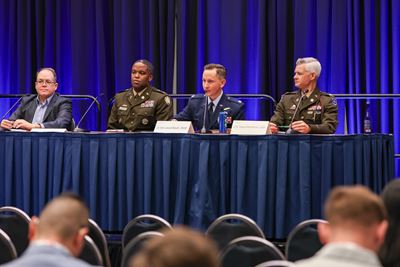
Key Themes from the Emerging Technologies Conference 2026
By Alexander Margolis
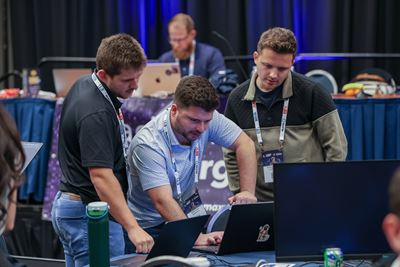
A month ago, ETC 2026 brought together national security leaders and innovators for a national security hackathon, breakout discussions, and insights from senior Department of War officials, including Chairman of the Joint Chiefs of Staff Gen. Daniel Caine. Across the conference, several key themes emerged:
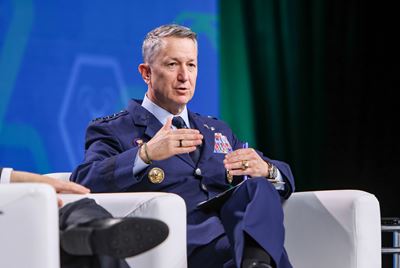
1. Department of War Reform
Speakers highlighted the need for comprehensive reforms to modernize the Pentagon. Vice Chairman of the Joint Chiefs of Staff Gen. Christopher J. Mahoney captured this, saying, "The obstacle [for DoW] is structural, and if we're serious about competing with the speed of technology, the structures surrounding the department must move with us." Speakers focused on three key areas of improvement:
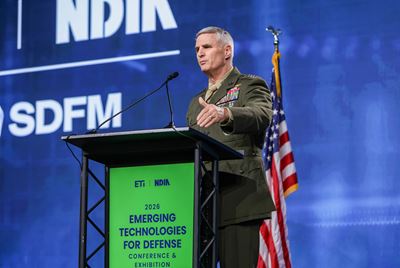
a. AI Use and Implementation
The first is AI adoption and implementation. Undersecretary of War, Comptroller Hon. Jules W. Hurst III emphasized AI’s role in helping DoW achieve a clean financial audit by 2028, saying, "Deploying AI-driven tools and advanced analytics is absolutely necessary to eliminate manual processes and accelerate remediation." Assistant Secretary of War for Research and Development Hon. Joseph S. Jewell also highlighted the discrepancy between DoW and private sector research, calling on the Pentagon to partner with the private sector to apply AI to both warfighting and administrative efficiency.
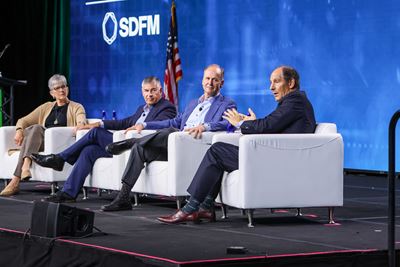
b. Acquisition Reform
Reforming the acquisition system was another key focus. Undersecretary of War for Acquisition and Sustainment Hon. Michael P. Duffey discussed reforms including the creation of Program Acquisition Executives (PAEs) to streamline the acquisition process and multi-year procurement deals to provide industry with a consistent demand signal. Hon. Hurst also emphasized speeding the flow of appropriated funds to program offices, saying, "Oftentimes it takes us almost two months to get [appropriated funds] down to the program offices and the units that are actually going to execute those dollars. Our goal is simple: we're going to break that down, change our processes, and change our systems to get that money out in as little as two weeks."
c. Revitalizing the Defense Workforce
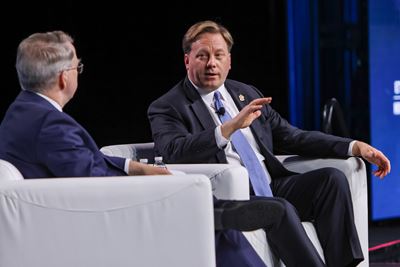
Finally, speakers emphasized the need to rebuild the defense workforce. Hon. Jewell noted that 20% of DoW’s S&T engineers are eligible for retirement, calling for more flexible hiring authorities and competitive salaries to retain talent. Undersecretary of War for Research and Engineering Hon. Emil Michael highlighted another critical issue: the shortage of skilled factory workers, which he described as the defense industrial base’s biggest chokepoint.
2. Scaling and Innovating at Speed
Another major theme was the need for industry to scale production and innovate faster. In accepting the James Forrestal Industry Leadership Award, Saronic CEO and former Navy SEAL Constadino “Dino” Mavrookas said, "This reindustrialization is our generation's version of the space race, and we have to win." Lt. Gen. Steven Marks, Commander of U.S. Special Operations Command (SOCOM) and director of the Defense Autonomous Warfare Group (DAWG), echoed this sentiment, saying, "The side that adapts fastest will have the advantage in the next war."
Hon. Michael highlighted specific areas that need to be scaled, saying, "We built hypersonic weapons. Now we have to scale them. We have to do them at less than $50 million a copy. Scale directed energy, which ended up being perfect for the drone fight we face." Hon. Duffey mentioned a recent example of DoW scaling at speed, saying, "When it comes to our munitions, $25 billion of private sector capital to triple or quadruple the production of our Patriot missile, our THAAD missile, and our Tomahawk."
3. High/Low Mix
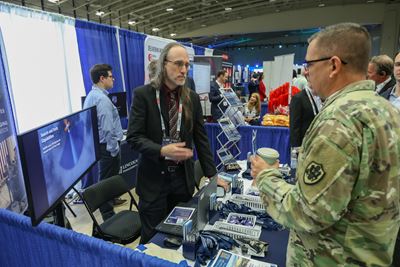
Speakers also emphasized the need for a high/low mix of military systems. Chairman Caine opened the conference by noting that "quantity is a quality all its own," a message echoed throughout the week. Hon. Hurst advocated for the use of both expensive and cheap systems saying, "We have to resource exquisite systems like the B-21 and Columbia-class submarines and integrate them in battlefield concepts with affordable mass, autonomous systems, and the ability to produce systems at scale."
Hon. Michael pointed out the necessity of retaining current systems as the U.S. Armed Forces make a shift towards affordable autonomous platforms. In addition, LTG Marks described the future force as one that will "combine sophisticated platforms with large numbers of low-cost, attritable, autonomous systems."

4. Emerging Technologies in the AFRICOM AOR
ETC also highlighted the role of emerging technologies in AFRICOM’s area of responsibility (AOR). Gen. Dagvin Anderson, Commander of AFRICOM, described the region as a "battle lab" for modern conflict, highlighting needs such as austere medicine, C-UAS, and precision strike. Several AFRICOM officers also led breakout sessions on contested logistics and innovation across the AOR.