
FEBRUARY 18, 2026
Innovation provisions in the enacted fy26 NDAA
Congress passes acquisition reforms reshaping defense innovation enterprise
By: Samuel Moyer & Ida Bagus Made Widyadnya
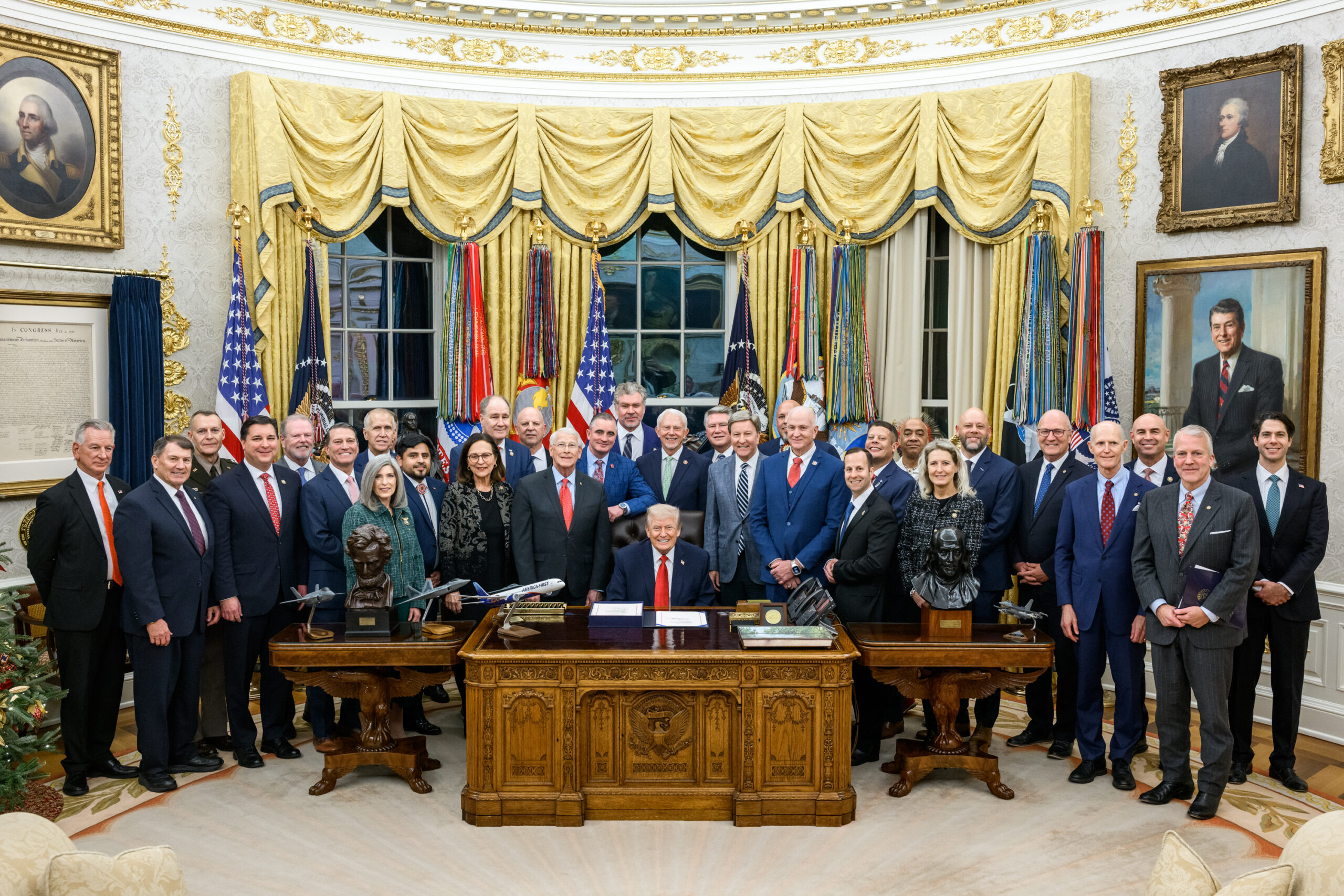 Image: Office of Rep. Jen Kiggans / U.S. House of Representatives
With the enactment of the FY26 National Defense Authorization Act (NDAA), Congress has approved one of the most far-reaching acquisition reform packages in decades. ETI previously reviewed the Senate and House versions of the legislation, before the HASC and SASC went into conference, and this edition offers an overview of the enacted provisions most relevant to defense innovation.
Parts of two cornerstone legislative packages—the Senate’s FoRGED (Fostering Reform and Government Efficiency in Defense) Act and the House’s SPEED (Streamlining Procurement for Effective Execution and Delivery) Act—were incorporated into the final NDAA and now carry the force of law. Collectively, some of the enacted provisions may prove to be among the most consequential acquisition reform efforts in recent memory, drawing comparisons to landmark statutes such as the Federal Acquisition Streamlining Act (FASA), the Weapon Systems Acquisition Reform Act (WSARA), and the McCain-Thornberry reforms of 2016.
At the same time, many of the most ambitious provisions were dropped from the final NDAA (a list of these can be found at the end of this article). The SASC and HASC conference committee prioritized measures that can be implemented within existing institutional and workforce constraints. This pragmatic orientation seems to have been reinforced by the unusually close alignment between Congress and the Department of Defense, with senior DoD leadership actively endorsing and helping shape many of the acquisition reforms now enacted.
For readers who would like a deeper dive on the FY26 acquisition changes, we recommend ETI’s Emerging Tech Horizons podcast episode featuring Dr. Arun Seraphin and Moshe Schwartz, which unpacks what changed, what did not survive conference, and what implementation may look like in practice.
MAJOR HIGHLIGHTS
Reforms for Efficiency and Reindustrialization
These provisions focus on revitalizing domestic manufacturing and supply chains, strengthening workforce capabilities, and enhancing efficiency across the industrial base, all while reducing reliance on foreign sources for critical goods and technologies.
SEC. 221 – REVIEW AND ALIGNMENT OF STANDARDS, GUIDANCE, AND POLICIES RELATING TO DIGITAL ENGINEERING
Directs a DoD-wide “clean-up and convergence” effort for digital engineering by requiring each Military Department to conduct a comprehensive review of its standards, guidance, and policies governing digital engineering tools (including digital twins and digital threads) across program design, development, and testing within 180 days. Each department must then develop and implement a standard reference architecture that sets clear lifecycle requirements for deploying digital engineering, defines data management/modeling standards, and explicitly weighs the use of consensus versus non consensus standards to speed adoption and reduce vendor lock.
SEC. 225 – ADVANCED ROBOTIC AUTOMATION FOR MUNITIONS MANUFACTURING
Directs the Army to launch a program to mature and expand the use of robotics and automation in ammunition manufacturing, particularly at government-owned, contractor-operated (GOCO) munitions plants. The final NDAA broadens this program beyond the original Senate proposal to now emphasize development of inherently safe and scalable robotic load/assemble/pack (LAP) systems, higher throughput, reduced manual handling of explosives, cyber-hardened infrastructure, and workforce upskilling in robotics. (The earlier Senate version required a briefing by March 1, 2026, which the final bill dropped.)
SEC. 832 – ENHANCEMENT OF DEFENSE SUPPLY CHAIN RESILIENCE AND SECONDARY SOURCE MANUFACTURING
Enhances DoD’s ability to quickly qualify additional sources for critical components. It authorizes measures to address issues of unreasonable pricing or single points of failure in the supply chain. (Unlike the Senate’s earlier proposal of 14-day “Expedited Qualification Panels”, the final version takes a broader approach to improving supply chain resilience.)
SEC. 834 & 835 – STRATEGIES TO ELIMINATE FOREIGN DEPENDENCIES (OPTICAL GLASS AND COMPUTER DISPLAYS)
Requires the Pentagon to develop strategies to end sourcing of critical optical glass and computer display components from non-allied nations by 2030. These plans aim to onshore or ally-source these vital materials (used in sensors, optics, cockpits, etc.), addressing a known vulnerability in the defense supply chain.
SEC. 914 – SMALL UNMANNED AERIAL SYSTEMS (SUAS) INDUSTRIAL BASE WORKING GROUP
Establishes a “Small-UAS Industrial Base Working Group'' to assess and strengthen the U.S. industrial base for small drones. The group will analyze current production capacity, identify critical component needs, and recommend investments or government-supported production (including potential government-owned contractor-operated facilities) to ensure a robust domestic sUAS supply chain. (Earlier proposals like the House’s SEC. 875 “Sky Foundry” pilot program were folded into this working group approach.)
SEC. 1842 – TRANSITION TO ADVANCED MANUFACTURING FOR CRITICAL ITEMS
Requires identification of critical defense items that could be produced via advanced manufacturing within 120 days. Relevant Product Support Managers must develop plans to transition these items to advanced manufacturing, including strategies for qualifying parts.
SEC. 1843 – WORKING GROUP ON THE ADVANCED MANUFACTURING WORKFORCE
Establishes a Working Group to identify career fields in advanced manufacturing, analyze workforce needs and gaps, develop training programs and apprenticeships, and collaborate with educational institutions. Addresses critical workforce shortages in advanced manufacturing that could limit adoption even as technologies mature.
SEC. 1846 – IMPROVEMENTS RELATING TO ADVANCED MANUFACTURING
Elevates advanced manufacturing as a priority in defense acquisition. Appoints the Under Secretary of Defense for Acquisition & Sustainment and the Under Secretary of Defense for Research & Engineering as co-chairs of the DoD additive manufacturing working group and additive manufacturing consortium and mandates updates to procurement guidance to incorporate digital design and automated production. It also calls for a formal certification program for defense suppliers using advanced manufacturing and the development of methods to qualify new processes.
Bolstering Biotechnology and Bioindustrial Innovation
A significant theme in the FY2026 NDAA is investment in biotechnology, from bioindustrial manufacturing to data and ethics. These sections aim to harness biotech for defense while building a resilient domestic bioeconomy.
SEC. 241 – SUPPORT FOR BIOINDUSTRIAL MANUFACTURING PROCESSES R&D
Expands a DoD initiative (started in FY2023 NDAA) that advances bioindustrial manufacturing using biological processes to produce materials, fuels, and chemicals at scale. The provision authorizes the Department to support research, development, and even facility design or construction related to bioindustrial production.
SEC. 242 – BIOTECHNOLOGY MANAGEMENT OFFICE
Requires designation of a senior DoD official for biotechnology and the stand-up of a Biotechnology Management Office within 120 days (under the Deputy Secretary of Defense). This office will oversee execution of a Defense Biotechnology Strategy, update acquisition policies to facilitate biotech adoption, coordinate efforts across the military and with industry, streamline regulatory approvals, and build international partnerships. It also must analyze global competition in biotech and address workforce and training gaps in this field. (Notably, the office is authorized through September 30, 2030. The Senate originally proposed 2035, but the final bill shortened it.)
SEC. 243 – BIOINDUSTRIAL COMMERCIALIZATION PROGRAM
Establishes a program to expand domestic bioindustrial manufacturing capacity. DoD may provide financial awards to projects that establish, modernize, or retool U.S. facilities for bio-manufacturing. Priority will go to efforts that improve defense supply chain resilience, onshore production of critical bio-based materials (fuels, polymers, or pharmaceuticals), and meet warfighter needs. The program also emphasizes geographic diversity, supporting bioindustrial facilities in various regions, ideally near feedstock supplies or existing industry clusters to strengthen the nationwide bioeconomy.
SEC. 244 – BIOTECHNOLOGY SUPPLY CHAIN RESILIENCY PROGRAM
Authorizes the Secretary of Defense to create a program for transitioning biotech research from labs into real-world defense supply chain applications. The scope is broad, including: evaluating supply chain vulnerabilities that biotech could address; funding applied R&D in areas like bio-based materials and biomanufacturing processes; prototyping and testing biologically derived materials (alternatives to petrochemicals or rare materials); upgrading infrastructure at DoD labs or partner facilities for biotech production; and fostering education and workforce development in biotechnology. The program must coordinate across military departments and with other agencies.
SEC. 245 – BIOLOGICAL DATA FOR ARTIFICIAL INTELLIGENCE
Recognizes the importance of large biological datasets for AI and machine learning applications in defense. This section mandates that DoD ensure valuable biological data are collected, curated, and stored with proper standards so they can be used to train AI models. It sets requirements for data quality (rich metadata, accuracy, completeness), interoperability, and tiered access controls with cybersecurity safeguards to protect sensitive information.
SEC. 246 – DEPARTMENT OF DEFENSE BIOTECHNOLOGY STRATEGY
Instructs DoD to develop a comprehensive strategy for biotech investment and utilization across the Department, due by June 1, 2026. It must address R&D priorities in bioengineering, biomanufacturing, biosecurity, and related areas, and coordinate efforts to keep pace with global competitors. Significantly, the final bill expands the strategy’s required elements: it calls for (1) creating a network of commercial biomanufacturing facilities accessible to DoD; (2) reviewing and updating military specifications to incorporate bio-based products; (3) exploring advance market commitments or offtake agreements to stimulate the bioeconomy; (4) integrating biotechnology into DoD wargaming scenarios; (5) launching a “grand challenge” program to make biotechnology more predictably engineerable; (6) investing in biotech regulatory science; and (7) coordinating with NATO allies for joint demand signals.
SEC. 247 – ETHICAL AND RESPONSIBLE DEVELOPMENT OF BIOTECHNOLOGY IN DOD
Mandates that the Department establish policies and procedures for the safe and ethical development, testing, and use of biotechnology. This includes guidelines for employing biotech in military training or operations in ways that ensure safety and adhere to ethical norms. DoD must also provide training for personnel on the implications and proper use of biotechnologies and create oversight mechanisms for any biotech applications that could have irreversible or long-term effects. (The final language is slightly less prescriptive than the Senate draft – for example, it does not explicitly list informed consent or specific treaty compliance, but those principles are to be addressed under broader guidelines.)
SEC. 851 – PROHIBITION ON CONTRACTING WITH CERTAIN BIOTECHNOLOGY COMPANIES (BIOSECURE ACT)
Enacts a government-wide ban on procuring biotech equipment or services from “biotechnology companies of concern,” i.e. firms that are owned or controlled by foreign adversaries or that provide sensitive multiomic data to such governments. The Office of Management and Budget (OMB) must publish a list of these banned entities within one year. DoD contractors and grant recipients will also be prohibited from using equipment or services from listed companies in fulfilling defense contracts. Waivers can be granted only for national security needs or medical emergencies. (The final version includes due-process measures such as notice and an opportunity to appeal for companies before being blacklisted, and a detailed definition of covered biotech products and services.)
Emerging Technologies for the Future Battlefield
These provisions seek to strengthen readiness for high-tech conflicts through the exploration of new capabilities, testing infrastructure, and operational integration of emerging technologies.
SEC. 224 – NATIONAL SECURITY AND DEFENSE ARTIFICIAL INTELLIGENCE INSTITUTE
Authorizes the establishment of one or more AI centers of excellence to spur AI education, research, and workforce development tailored to defense needs. These institutes will collaborate with universities, industry, federal labs, and nonprofits and provide resources like open datasets and testbeds for AI development. Each institute can receive DoD funding for an initial 5-year term (with potential 5-year renewal). By training military and civilian personnel in AI and accelerating cutting-edge research, the institutes aim to cultivate an AI-ready workforce and speed adoption of AI-enabled capabilities across the Armed Services. (While the House’s earlier version envisioned a single institute, the final NDAA allows multiple institutes at different host institutions, broadening the impact.)
SEC. 226 – EVALUATION OF ADDITIONAL TEST CORRIDORS FOR HYPERSONIC AND LONG-RANGE WEAPONS
Directs the DoD to study and report options for expanding test flight corridors for hypersonic and other long-range weapons. This includes evaluating potential new testing areas or routes involving both Federal Aviation Administration (FAA) airspace and DoD-controlled locations to allow more frequent and realistic testing of hypersonic missiles. The final language adds requirements to assess how to increase the test cadence (number of flights), whether special-use airspace should be designated temporarily or permanently for such tests, what a continental U.S. hypersonic range network would require, and how existing test facilities (like Pacific ranges) can be enhanced.
SEC. 863 – USSOCOM “URGENT INNOVATIVE TECHNOLOGIES AND CAPABILITIES” INITIATIVE
Establishes an initiative within U.S. Special Operations Command to rapidly develop and field innovative technologies to meet special forces’ urgent needs. Initially conceived as a five-year pilot program with expedited acquisition authorities, the final version authorizes SOCOM to identify emerging operational requirements and pursue quick-turn solutions outside the standard procurement process. (The House had proposed broader rapid acquisition powers for SOCOM, while the enacted provision is narrower but still enables more agile procurement aligned with high-priority SOCOM needs.)
SEC. 1603 – ACQUISITION AND OPERATION OF SPACE SYSTEMS FOR SPACE WARFIGHTING
Grants the Secretary of Defense authority to acquire and field space systems specifically for warfighting and space superiority missions. Clarifies that DoD can develop or buy military space capabilities (satellites, space sensors, etc.) and operate them for defense purposes. It also encourages leveraging commercial space services to augment military systems when feasible. (The final text is more expansive than House proposal SEC. 1606 that was limited to Tranches 4-6 of SDA’s proliferated architecture. It encompasses all space acquisition relevant to combat operations.)
SEC. 1651 & 1652 – “GOLDEN DOME” COMPREHENSIVE MISSILE DEFENSE POLICY AND SYSTEM
Updates U.S. missile defense policy to endorse a “Golden Dome for America” and call for deploying and maintaining a next-generation missile defense shield to deter and defend the United States, its citizens, and critical infrastructure against ballistic, hypersonic glide, and cruise missiles and other advanced aerial threats (as opposed to the earlier policy focused mainly on rogue-state ICBMs). SEC. 1652 provides reporting and oversight requirements for the development of the Golden Dome system itself. The Pentagon must present cost estimates and schedules for achieving full operational capability and conduct rigorous testing. (This section merges elements from both chambers. The Senate pushed for regular briefings and a program manager for homeland missile defense, while the House called for a detailed architecture plan within 180 days.)
SEC. 1682 – INTEGRATION OF ELECTRONIC WARFARE (EW) INTO TIER-1 AND TIER-2 EXERCISES
Requires that the military’s highest-priority joint exercises (Tier 1 and 2) include realistic EW scenarios and capabilities from FY2026 through FY2030. Exercises must feature opposing forces employing adversary-like EW capabilities based on the latest intelligence. The Chairman of the Joint Chiefs can waive this requirement only if EW is not relevant to an exercise’s purpose or if technical limitations make it infeasible. Annual briefings are required on the planned exercises and results of completed exercises.
Improving Defense Acquisition and Industrial Base Policy
Several sections in the NDAA aim to reform how the Department contracts and invests, to make acquisition faster and more secure, and to strengthen the industrial base through policy changes and new authorities.
SEC. 211 – MODIFICATION TO AUTHORITY TO AWARD PRIZES FOR ADVANCED TECHNOLOGY ACHIEVEMENTS
Expands DoD’s ability to run and scale prize competitions by updating 10 U.S.C. § 4025 to explicitly include the Director of the Defense Innovation Unit (DIU) among the officials authorized to execute prize programs, and by doubling key statutory prize thresholds to enable larger, more consequential competitions. Specifically, it raises the maximum fair market value of an individual prize from $10M to $20M, increases the aggregate cap on cash prizes from $1M to $2M, and doubles the approval threshold for solely non monetary prizes from $10K to $20K, while also aligning the congressional notification trigger with the new $20M ceiling.
SEC. 833 – INTERIM NATIONAL SECURITY WAIVERS FOR SUPPLY CHAIN TRANSPARENCY
Creates a “safe harbor” for defense contractors that proactively audit their supply chains and discover prohibited foreign components. If a contractor, during voluntary supply chain illumination efforts, finds a non-compliant or foreign-sourced item, they can disclose it to the government and receive an interim waiver allowing them to deliver the item under an existing contract. Contractors must still ultimately replace the foreign item, but the waiver gives them time to do so without disrupting defense programs.
SEC. 867 – MODIFICATIONS TO DEFENSE INDUSTRIAL BASE FUND (DIBF)
Significantly expands allowable uses and authorities of the Industrial Base Fund. The section broadens its authorities to allow a range of interventions. New authorized uses include providing grants or loans to strengthen domestic production of critical materials (e.g., rare earths, batteries), providing offtake-like purchase guarantees, funding workforce training programs, and entering public-private partnerships to scale up manufacturing. In combination with the $8.3B expansion of the Industrial Base Fund via the 2025 One Big Beautiful Bill reconciliation, these authorities could greatly expand the Industrial Base Fund's role in US industrial policy. (See the separate Private Capital Investment article for full details.)
SEC. 906 – ADDITIONAL AUTHORITIES FOR THE OFFICE OF STRATEGIC CAPITAL (OSC)
Authorizes the Office of Strategic Capital to collect fees for due diligence and loan monitoring, accept in-kind services, and use third-party contract support for financial, legal, or consulting services. Moreover, loan agreements made by OSC will carry a “presumption of compliance” with certain federal rules.
SEC. 1601 – ACQUISITION CAREER PATH IN THE SPACE FORCE
Requires the U.S. Space Force to establish a formal acquisition career pathway for its officers. This includes developing training, education, and assignment structures tailored to building expertise in acquiring and managing space systems. The provision also addresses workforce alignment between the Space Force and organizations like the National Reconnaissance Office to ensure talent is properly distributed and retained.
Scaling and Securing Artificial Intelligence
These provisions push the DoD to operationalize AI at scale and create stronger governance, security, and oversight guardrails.
SEC. 347 – INTEGRATION OF COMMERCIALLY AVAILABLE AI CAPABILITIES INTO TRAINING EXERCISES
Instructs the Department to incorporate off-the-shelf artificial intelligence tools to assist with logistics tracking, planning, operations, and analytics into two military exercises.
SEC. 547 – PILOT PROGRAM FOR GENERATIVE ARTIFICIAL INTELLIGENCE AND SPATIAL COMPUTING
Launches a pilot program exploring the use of generative AI (e.g. large language models, AI image/video generation) and spatial computing (augmented reality/virtual reality) to enhance military training and operations. (The Secretary of the Navy is directed to implement this pilot to train sailors using AR/VR environments and AI-generated scenarios.)
SEC. 1512 – ARTIFICIAL INTELLIGENCE AND MACHINE LEARNING SECURITY IN DOD
Mandates the creation of a comprehensive cybersecurity and risk-management policy for all AI and machine learning systems used by the Department. Within 180 days, DoD must establish guidelines covering the use of cybersecurity measures throughout the entire AI lifecycle, secure development practices, testing and validation, requirements for AI models to be traceable and auditable, and adoption of industry security standards for AI. It also extends concepts like the software bill of materials to AI. In addition, this section calls for AI-specific adversarial testing to observe how AI performs under attack or deception, continuous monitoring of fielded AI systems for vulnerabilities, and training programs to raise AI security awareness among personnel.
SEC. 1513 – PHYSICAL AND CYBERSECURITY REQUIREMENTS FOR AI SYSTEMS
Requires the Department of Defense to develop a risk-based framework for securing AI systems within the acquisition process. This includes establishing cybersecurity and physical security standards for vendors and AI-enabled products. The framework is expected to build on existing models such as the Cybersecurity Maturity Model Certification (CMMC), while adapting to AI-specific risks, including adversarial attacks, supply chain vulnerabilities (such as tampered chips or code), and secure handling of training data.
SEC. 1531 – PROHIBITION ON USE OF CERTAIN ARTIFICIAL INTELLIGENCE
Bars the Department from using specific high-risk AI software tied to foreign adversaries. The Secretary of Defense must within 30 days identify any “covered” AI, explicitly including AI developed by the Chinese firm DeepSeek or entities backed by “High Flyer”, and remove it from all DoD systems. DoD contractors are also prohibited, after that 30-day window, from utilizing such banned AI in performing contracts.
SEC. 1533 – ARTIFICIAL INTELLIGENCE MODEL ASSESSMENT AND OVERSIGHT
Establishes a cross-functional oversight team, led by the Chief Digital and Artificial Intelligence Officer, to govern the development and deployment of major AI systems across the Department of Defense. The team will include chief artificial intelligence officers from each military department and combatant command and will be responsible for setting standardized processes to assess and validate AI models, particularly those used by at least 500 users annually, and employed operationally for core military and departmental functions. Before deployment, these models must undergo evaluation for performance, safety, security, and ethical compliance.
SEC. 1534 – DIGITAL SANDBOX ENVIRONMENTS FOR AI
Requires the Department of Defense to establish secure, isolated virtual environments for artificial intelligence experimentation, development, and training. A task force, jointly led by the Chief Digital and AI Officer and the Chief Information Officer, must implement these environments by April 1, 2026. These digital sandboxes will allow service members, developers, and non-traditional users to safely test AI models and datasets without exposing operational systems to risk. They will also function as training platforms where personnel can gain hands-on experience with AI tools. The environments are intended to support a broad spectrum of users, from beginners to advanced practitioners, and are expected to be operational across the Department by 2030 to accelerate innovation through iterative testing and secure experimentation.
SEC. 1535 – ARTIFICIAL INTELLIGENCE FUTURES STEERING COMMITTEE
Establishes a high-level steering committee tasked with anticipating the implications of emerging artificial intelligence technologies on defense missions and command structures. The committee will monitor developments in advanced AI models, including the potential for general purpose AI and evaluate how these technologies might affect military operations, command and control, and national security strategy. It will develop recommendations on maintaining human oversight of AI systems, countering adversary AI capabilities, and leveraging AI to enhance U.S. strategic advantage. (The Senate version was titled "ARTIFICIAL GENERAL INTELLIGENCE STEERING COMMITTEE" with a narrower focus on AGI specifically. The final provision broadens to "AI Futures" covering advanced AI generally.)
Dropped Innovation Proposals: What Was Cut and What It Signals
Several forward leaning tech and innovation proposals that appeared in earlier drafts of the NDAA were ultimately cut during conference negotiations. These cuts likely underscore that while the FY26 NDAA is expansive overall, conferees prioritized implementable, consensus driven innovation provisions and concentrated legislative bandwidth on the bill’s central deliverable: large scale acquisition reform.
In the innovation portfolio, conferees pared back or removed a number of ambitious initiatives that would have expanded the scope of new programs or imposed aggressive scale targets. Early drafts included plans to boost R&D capacity at minority serving universities, create regional advanced manufacturing hubs to spur dual use innovation, and push the Department to dramatically expand additive manufacturing qualification goals (including proposals framed around very large “parts qualification” target by 2027). In addition, the House unsuccessfully pursued plus ups for cutting edge efforts such as SOCOM advanced drone development and a Navy quantum communications testbed. Both chambers also proposed SBIR/STTR changes, including making “Direct to Phase II” more durable.
Restrictive research-security provisions were also narrowed substantially. The House-passed SAFE Research Act, which would have banned funding to any researchers with affiliations to foreign adversaries, along with a plan to impose a three-year employment ban on DoD researchers affiliated with such entities were excluded from the final bill. In a similar vein, the Senate’s proposal to prohibit contracts between certain foreign entities and institutions of higher education conducting DoD funded research also did not carry through to the final agreement. Instead, lawmakers chose narrower measures (including a limited one-year extension of existing restrictions with case-by-case waivers) and a new prohibition focused specifically on Chinese-connected biotech firms.
Several supply chain and industrial base security provisions were also either excluded or substantially modified. House language restricting Department of Defense procurement of certain foreign adversary linked technologies (e.g., solar photovoltaic modules and OLED display technologies) was not adopted in its proposed form, likely in consideration of near-term supply chain impacts. Likewise, the proposed establishment of a fully funded “SkyFoundry” pilot program to enhance small unmanned aerial system (sUAS) manufacturing capacity were debated but not included. Instead, lawmakers opted to create a working group to study ways to improve the sUAS industrial base.
Taken together, the final FY26 NDAA favors targeted initiatives and measured innovation policy changes, paired with a sweeping push to modernize the acquisition system. The onus is now on the Department to implement these changes, and for future Conferences to consider other changes once implementation lessons emerge.


